
Digital guide · PDF
The First Ninety Days
Bringing a puppy home: the routine, the training and the ordinary problems, week by week.
A training and routine guide, not veterinary advice. Vaccination, worming, neutering, diet and anything to do with your puppy’s health belong with your own vet, who has met the dog — and the book sends you there rather than answering for them.
£15.00
One payment. No subscription, no app.
- Delivered immediately, by email.
- Yours to keep, on any device you own, and to print.
- Nothing is posted, so the checkout asks for no delivery address.
The week before a puppy arrives is worth more than the week after it, and almost nobody uses it.
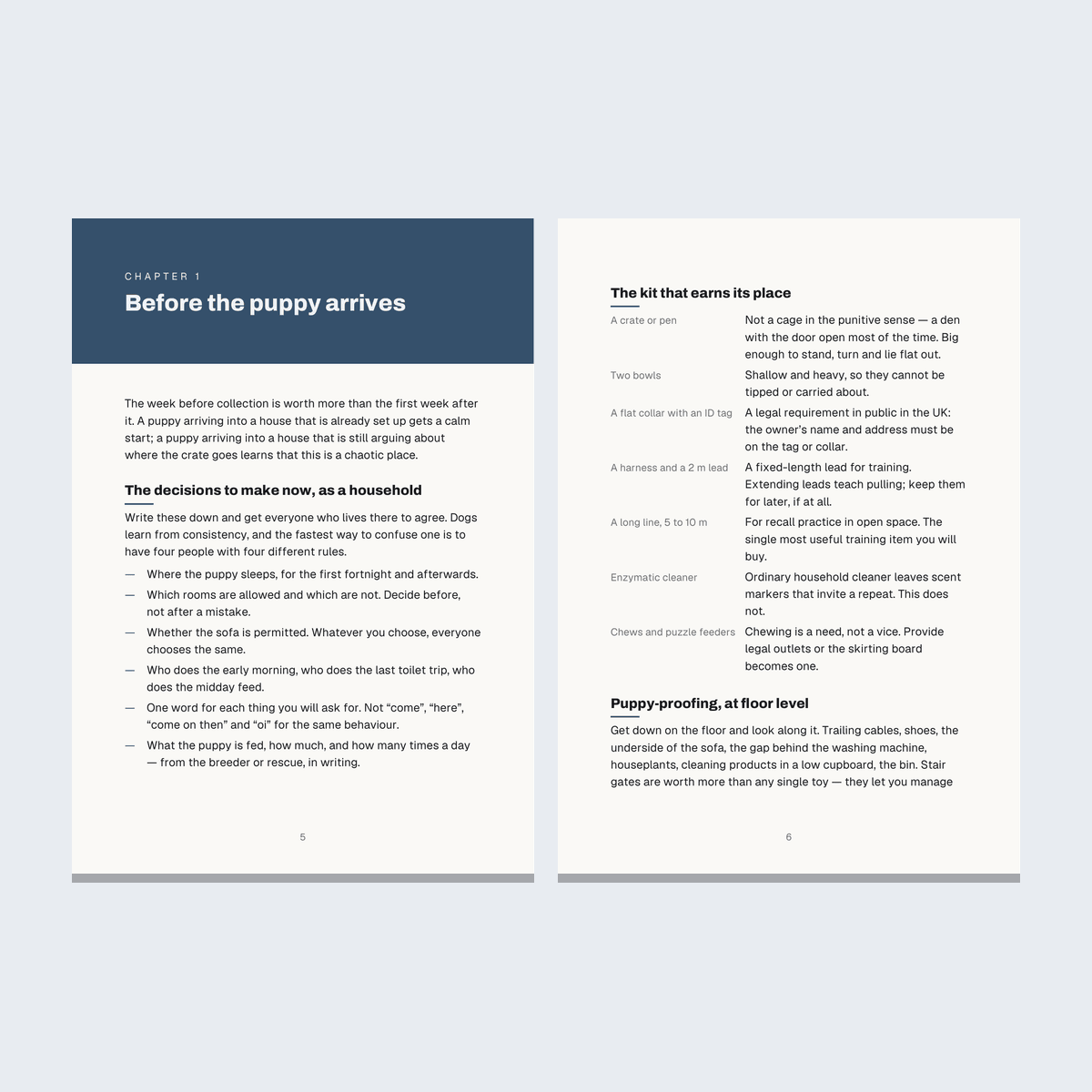
The First Ninety Days is a thirty-three page guide to a puppy's first three months in your house: what to decide before collection, what day one should look like, how house training actually works, how to build sleep and time alone, and what to do about the biting phase that makes more people despair than anything else.
It is a training and routine guide, not veterinary advice — and it is explicit about the line. Vaccination, worming, neutering, diet and anything to do with your puppy's health belong with your own vet, who has met the dog. Where the guide says ask your vet, it means it.
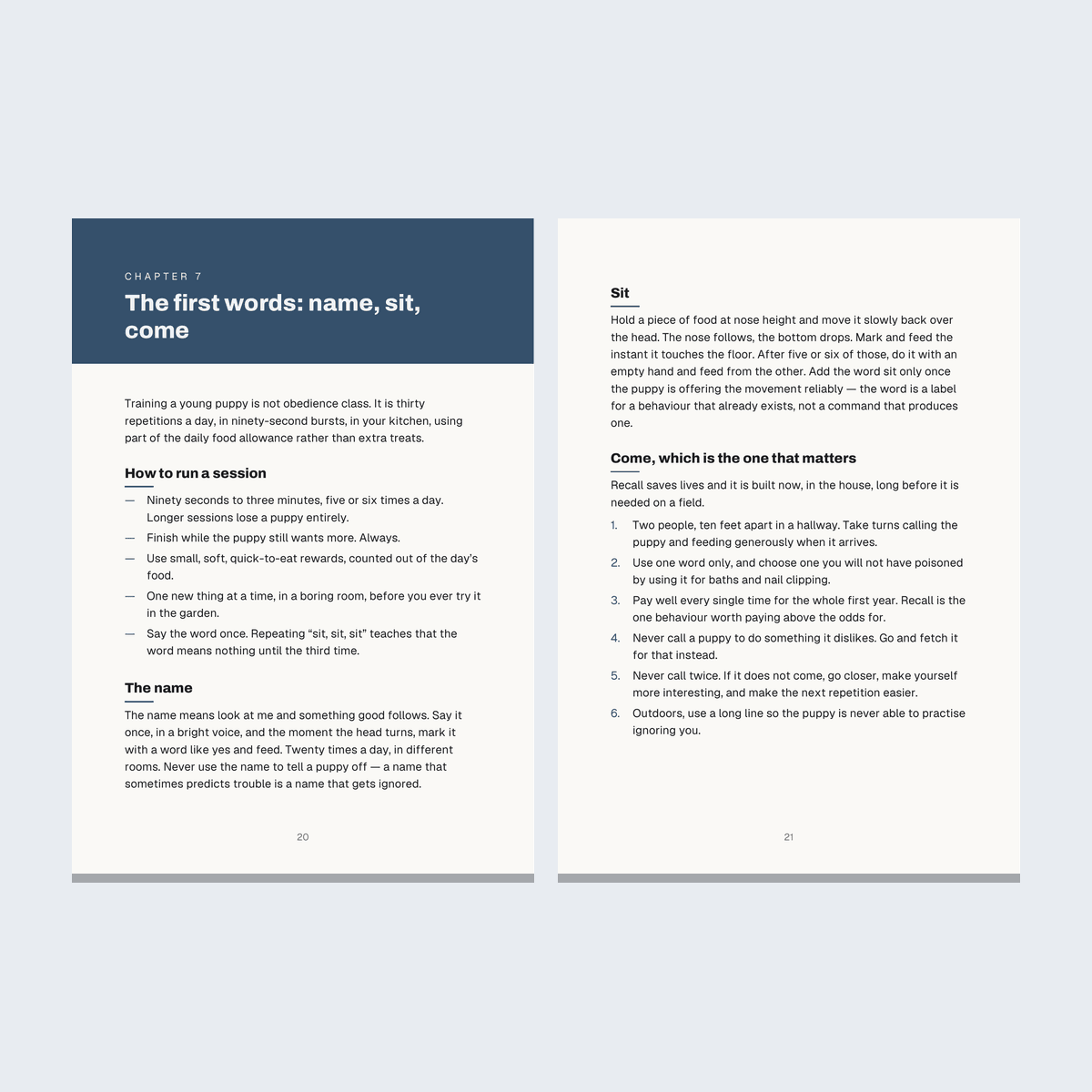
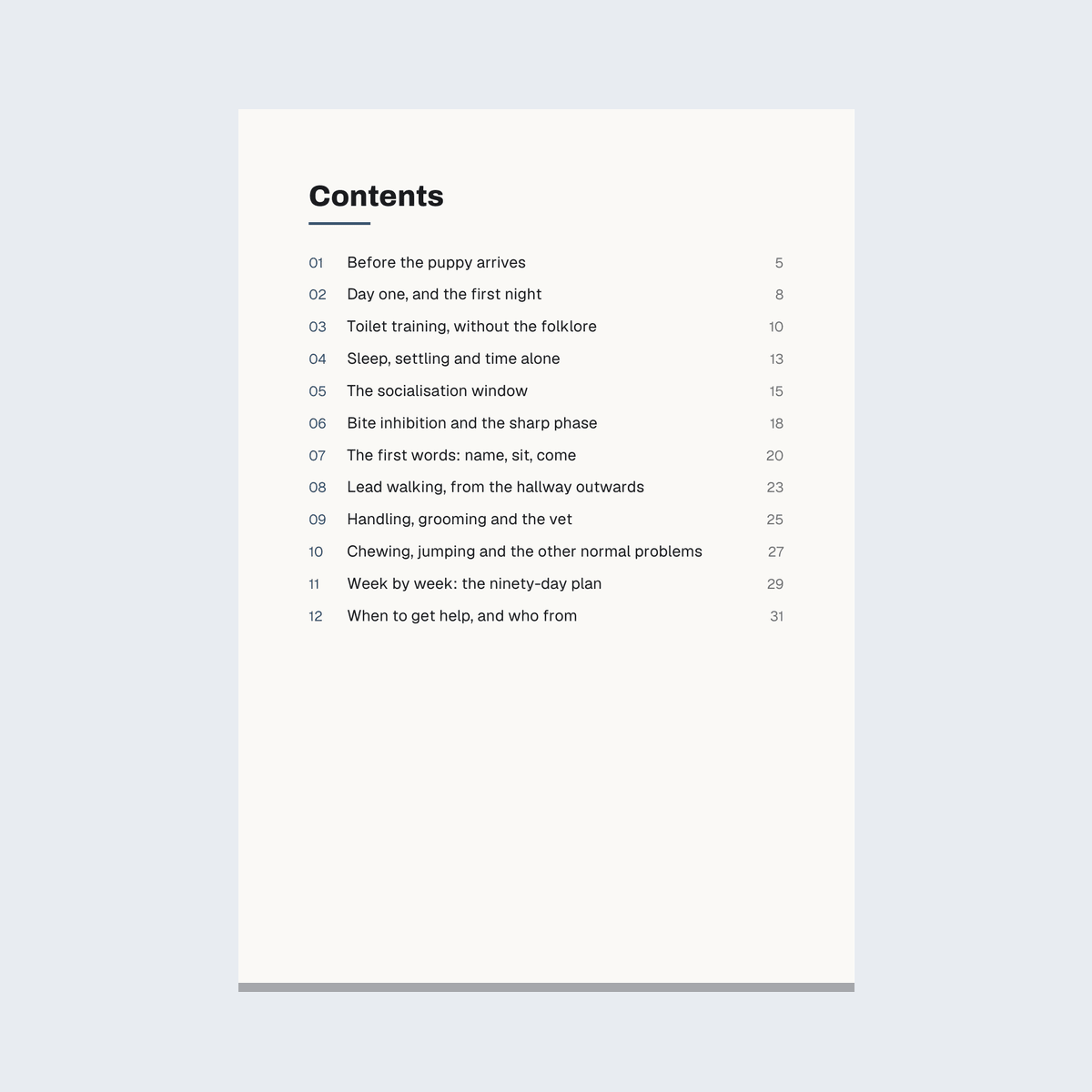
Twelve chapters, a week-by-week ninety-day plan you can put on the fridge, and a final chapter on when to stop working alone and get help — including how to choose someone in an industry that is unregulated.
The ninety days, week by week
Printed in the back of the book to go on the fridge. Ages are approximate: a puppy that arrives at ten weeks starts at week one of this plan, not week three of it.
Week 1
Settle only. Toilet schedule, sleep schedule, one room, no visitors.
Week 2
Ninety-second training sessions. First seconds of being alone. Two minutes of handling a day.
Week 3
Recall in the hallway. Harness and lead indoors. Crate door closed for seconds at a time.
Week 4
Lead walking in the garden. Two or three socialisation items every day.
How it is written
Most of it is decided before the puppy arrives
Where it sleeps, which rooms are allowed, who does the early morning, and one word for each thing you will ask for. Dogs learn from consistency, and the fastest way to confuse one is four people with four different rules. The first chapter is a household conversation with a list attached.
Sleep is the first training tool
An overtired puppy looks exactly like a badly behaved one — frantic, biting, unable to hear you. Puppies do not put themselves to bed, and a great deal of what people describe as a difficult week three is a puppy sleeping eleven hours instead of eighteen. The guide treats enforced naps as a technique, not a kindness.
It draws the line at the vet's door
This is a book about routine and training. Vaccination timing, when a puppy may safely be on the ground in public, worming, diet and neutering are veterinary decisions that depend on the individual dog, and the guide sends you to your own vet for every one of them rather than guessing on your behalf.
Prevention, while it is still cheap
Time alone, handling, the crate, the vet's waiting room, nail clippers — all of them are taught in seconds-long repetitions in the first weeks, and all of them are far harder to fix later. The guide is honest about which chapters are time-critical and which can wait.
- Twelve chapters, thirty-three pages, from before collection to the end of month three
The file itself
- Format
- PDF, A5, unlocked and printable
- Length
- 33 pages, 12 chapters
- File size
- 142 KB
- Language
- English (British)
- Covers
- Roughly 8 weeks to 5 months of age
- Reads on
- Phone, tablet, laptop, e-reader, or paper
- Delivered
- By email and on screen, as soon as payment clears
- Licence
- One reader. Print it, keep it, do not resell it
In the download
- The First Ninety Days — 33 pages, PDF
- The twelve-chapter routine, from before collection to month three
- A week-by-week ninety-day plan for the fridge
Questions
Is this veterinary advice?
No, and it says so on its own imprint page. It is a training and routine guide. Vaccination, worming, neutering, diet and any health question belong with your own vet, who has met your dog — and the guide sends you there rather than answering for them.
My puppy is already twelve weeks old. Is it too late?
No. The plan starts from the day the puppy arrives with you, not from a particular age, so an older puppy simply starts at week one of the plan. The socialisation chapter is the time-critical one, and it explains what to prioritise if you are starting later.
What training methods does it use?
Food, management and short repetitions. It is explicit about what not to do — no holding the muzzle, no pinning, no scolding after the fact, and no equipment that works by causing discomfort — and it explains the cost of each in terms of what it does to the dog's trust.
Is it breed-specific?
No. The routine, house training, sleep, socialisation and handling chapters apply to any puppy. Where breed matters — the amount of lead walking a large or giant breed should do while growing — it tells you to ask your vet rather than printing one number for every dog.
How is it delivered?
As a download link on the confirmation page and in your receipt email, as soon as the payment clears. Nothing to install and no account to create.
What if the file will not open?
Write to us and we will resend it or send it in another form. Your legal rights over digital content are set out in full on the refund page.
How it reaches you
You pay, and the download link appears on the confirmation page and in your receipt email. Delivered immediately, by email. Nothing to install, no account to create.
Because the file is supplied straight away, the checkout asks you to confirm you want it immediately and that you therefore give up the 14-day right to cancel. That consent is recorded with your order.
Your rights if the file is faulty, will not open, or is not what this page described are unaffected by that, and are set out in full on the refund page.